In June 2025, driven by a deep desire to explore new nuances in my photography and to learn to look at the world through a slower, more mindful lens, I took part in a very special workshop. Held by Emiliano Cribari in the timeless setting of Florence, it was the beginning of a journey made of light, quiet moments, and shared perspectives…
A little step back: who is Emiliano Cribari?
I first came across Emiliano through his book La cura della pioggia. Piccolo omaggio alla malinconia che allieta (The Rain Cure: A Small Tribute to the Melancholy That Cheers), published in 2023 as part of the Piccola filosofia di viaggio series by Ediciclo Editore. It isn’t hard to see why this text fascinated and touched me so deeply: in its pages, Emiliano guides us into the woods on a rainy day. It is only there that we understand how surrendering to the rain makes us more present, fluid, and sensitive. Rain softens sounds; it invites us to lower our voices, to quieten our egos, and, finally, to truly listen. All of this resonates perfectly with my own search for slowness and for myself.
I was also fortunate enough to attend one of his photography presentations during a meeting organized by the Gruppo Fotoamatori Pistoiesi. During the evening, he shared some of his photographs which, I must say, powerfully convey a sense of time and lived experience. I am no critic, so I will leave it to the experts to pass technical or thematic judgment on his work. I will simply tell you that his photographs stirred something deep inside me.
June 2025: a photography and creative writing workshop by Emiliano Cribari
He welcomed us under the shade of a large tree in the back garden of a literary café, explaining that our time together would unfold through two creative exercises. For the first one, we began with a photograph he had gifted to each of us; our task was to write down how that specific shot made us feel, and the reasons why we had been drawn to choose it.
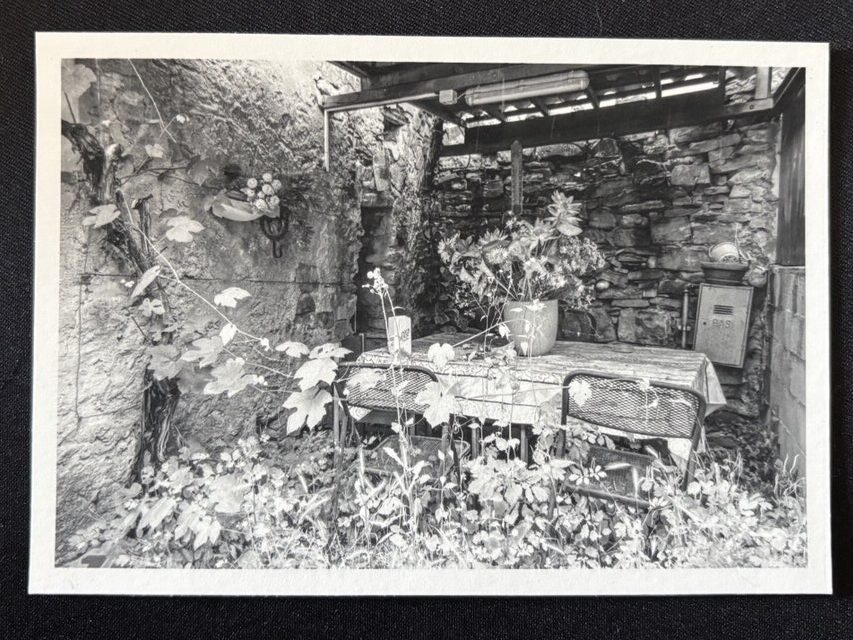
The photograph I chose was this one: a table with a large vase of flowers set inside a space that felt deeply lived-in, yet had clearly been abandoned for a long time.
I wasn’t very practiced with writing, so I limited myself to making a bulleted list of three semantic fields:
- Abandonment: of a building, of one’s roots, as a sense of emptiness caused by a loss;
- Family: conviviality, dialogue with one’s parents, the memory of meals shared around the same table;
- Origin: of oneself, of one’s growth, of one’s passions.
The photograph I drew from the deck he offered brought me right back to the days when I used to return to my parents’ house, the home where I grew up, and spend time with them. Time that, as I grew older, I came to appreciate more and more. Time that I carry inside me today, like memories both heavy and beautiful, and for which I am deeply grateful. Moments and conversations with them that I will never be able to have again, and which, for that very reason, are of priceless value.
I must say, this exercise was incredibly powerful and, in a way, therapeutic. It forced you to lay something of yourself, of your inner life, on the table in front of a room full of strangers who were about to do the exact same thing. It was deeply liberating; speaking with people you have never seen before about a piece of your soul allows you to drop all filters.
The second exercise consisted of taking a few photographs around Florence with the intention of anchoring whatever we captured within our own memory. In that moment, you have to strip away all artifice and accept the idea of being content with the true nature of things, keeping in mind the principle that photography is an educational act. This is because when you shoot on the streets, it is essential to maintain an ethically sound approach toward others. Before photographing a subject, you need to establish a dialogue and ask for their permission. This is precisely why I chose not to photograph people: unfortunately, I carry inside me this persistent feeling of disturbing others, of being a potentially bothersome presence even when I am just walking down the street. It’s the reason why I am always rushing and always fear spending too much time in a shop or a public space. I hope to overcome this fear one day, but that is not the focus of the article you are reading, so let me get back on track.
These are the photographs I gathered during those two hours around Florence. Because they were shot in different formats, I’ve had to crop them in the previews to briefly show you what they are about:
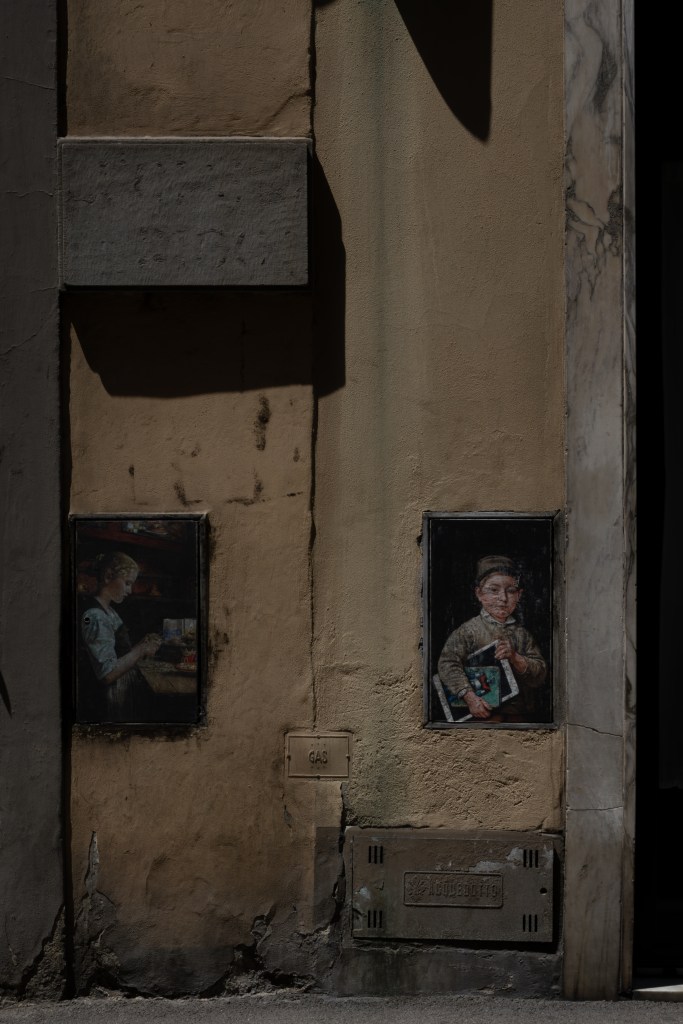
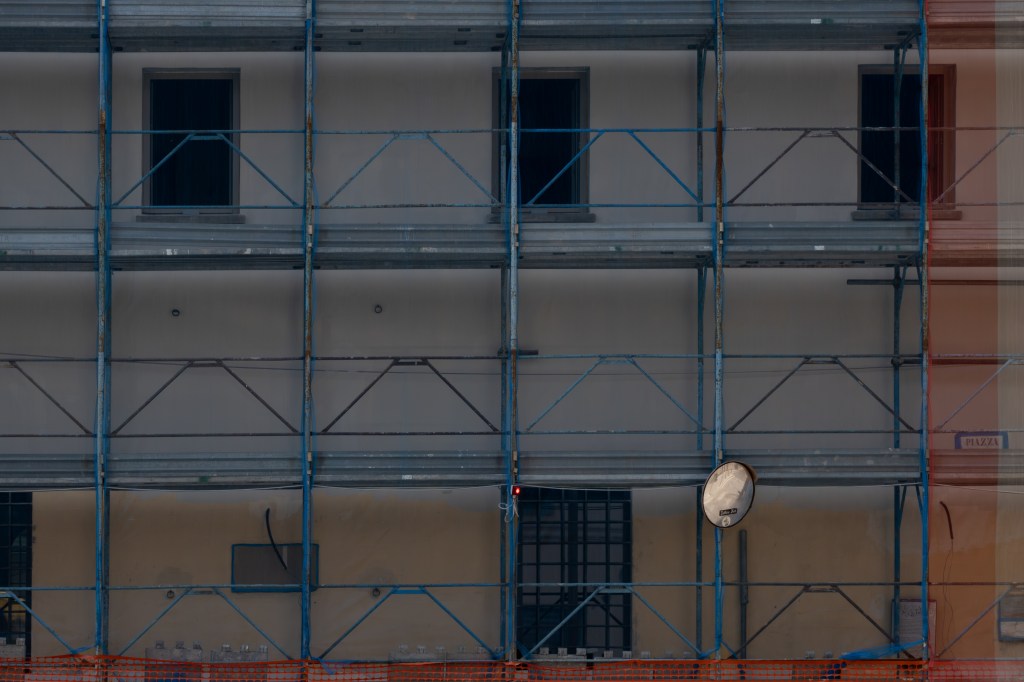
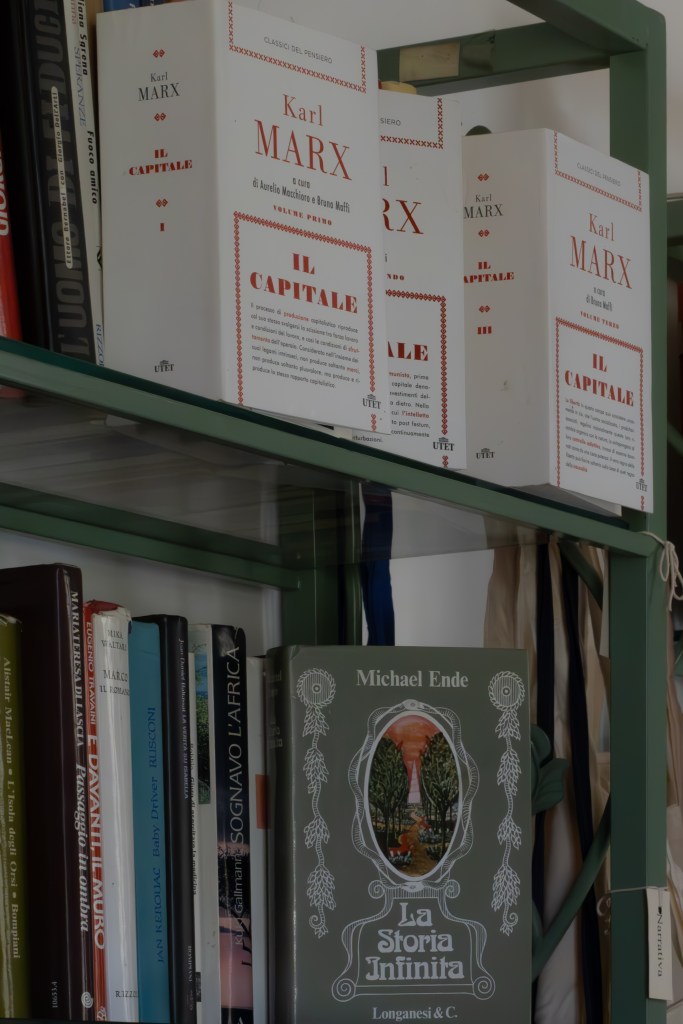
You can view the full photographs by clicking on them, and they will also be featured on the Fragments page, which is dedicated to the photography I capture.
Out of the three, I decided that the first one, taken at number 2 (Casa S. Felice) on Via Romana, was the most appropriate for the final presentation. I gave it the title Innocenza (Innocence), simply because it features two portraits of children, naively separated by a border labeled gas.
Here is Innocenza in its entirety. It is the shot from that workshop that brought me the most satisfaction, so much so that I submitted it to a national competition hosted right in the city where I was born. It feels a bit like a circle coming to a complete close: I started from the memory of days spent with my parents, only to return to my hometown with a final work born from a reflection on the past. All originating from a single black and white photograph.
Fiuzzi d’Oro: from Innocenza to L’ombra della guerra
I became very attached to the photograph I chose for the final exercise of the workshop because, in a way, it marked my transition from one worldview to another, one that was a bit more critical, a bit more photographic. So, I decided to enter it into a competition hosted right in my hometown: Fiuzzi d’Oro, which celebrated various artistic fields, including visual imagery. When submitting it, I decided to update its meaning, giving it a broader and less personal context (perhaps a mistake?). To me, it felt like a representation of how the geopolitical environment we live in harms children affected by conflict, robbing them of play and learning. The word gas echoed within me, bringing to mind the atrocities endured by people in concentration camps and the inevitable analogy with the present day, where we witness a nation attempting to exterminate a population every single day, not only by physically killing human beings, but by trying to wipe out their history and culture. Thus, in presenting the photograph to the competition, I renamed it L’ombra della guerra (The Shadow of War), as a reflection of the extermination we are currently witnessing.
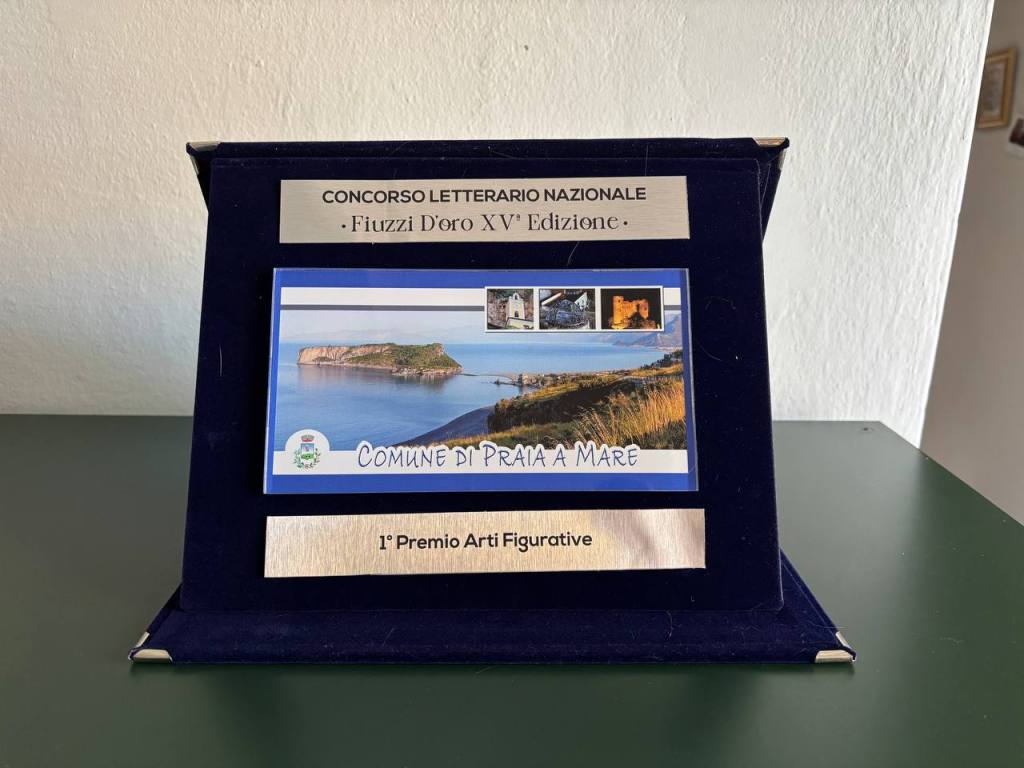
L’ombra della guerra received excellent feedback. The message was clear and beautifully interpreted by the jury, and it won 1st prize in the Figurative Arts category.


Leave a Reply